Nov 21, 2009

Deleted Scenes

I thought I might just post a few of the deleted scenes from Heart of the Beast. These were cut by my agent primarily because she felt they disrupted the plot action too much. I wrote them to address the larger theme of the book, which explored the human capacity for good and evil. The following was one of my favorite scenes in the book. Sigh. Oh well. Maybe I can use it in a future novel. Anyway, enjoy! (FYI: Robert is the vampire's name.)

"The warbling wail of the warning sirens came first. Soon, a chorus of droning, sputtering engines joined in, the sound of approaching planes, descending like a swarm of ravenous locusts. Then percussion punctuated the cacophony: whistling bombs, booming blasts, and the sharp cracks of shattering glass, bricks, and mortar. The ground violently quaked. Finally, there arose the sounds of human suffering in the street below. Whimpers, screams, sobs, and moans.

“Every few minutes, new waves of planes buzzed overhead like an agitated hive of bees. The gunfire popped and spit intermittently. Some shots were near and sharp, others distant and muffled. The bombs fell in batches, flashing brilliantly when they hit before shrinking to pinpoints of dazzling phosphorescent white. Now and then, leaping tongues of searing yellow would burst out of the white to declare that yet another structure had ignited in flames.

“With each batch of bombs, the window before me rattled menacingly and the floorboards violently shook under my feet. I could smell the acrid smoke and hear the crackle of the nearest blazes. The whole city, it appeared, was burning. What was left of it, anyway. The night sky glowed a brilliant orange red as flames leapt hundreds of feet into the air. Plumes of ghoulish smoke rose into a sickly pink cloud that hovered menacingly overhead and stretched as far as the eye could see. In the distance, I could just make out the shadowy silhouette of the great dome of St. Paul’s Cathedral illuminated by a halo of fire. Everywhere else, I saw only the shifting shadows of death, destruction, and despair.

“When the sirens finally stopped, I looked back through the window to the street below. In the warm, flickering glow of the fires, I could make out throngs of frightened humans now pouring out of the shelters, stumbling over the rubble of fallen buildings, making their way back to their homes—hoping and praying that their homes were still there for them to go back to. Most would not be. The city had been decimated by the unrelenting blasts. More than one million homes had already been destroyed. I was quite certain that it was only a matter of time before one of the bombs hit our residence, destroying the house and probably me, Fanny, and Edmund along with it. ‘The worst is over,’ I told my friends. ‘For now.’ I looked despondently from the window to the faces of my friends. I saw in their expressions the same relief I felt inside, knowing that we had survived another evening of the Blitz.

“For forty consecutive nights, the Germans had been bombarding London and her civilian inhabitants. The death toll had already reached forty thousand. And it was still climbing. I knew all too well that tonight’s attack would leave thousands more dead or homeless. At least I and the Mansfields were not among them. Not yet anyway.

“It all started at around four o’clock in the afternoon on September 7, 1940. The appearance of hundreds of German bombers and fighter planes in the skies over London heralded a tactical shift in Adolf Hitler’s attempt to bring Great Britain to its knees. For two months prior, in preparation for a planned invasion of the British Isles, the Luftwaffe targeted British airfields and radar stations for destruction. When the invasion plan was abandoned, Hitler hatched a scheme to destroy London, hoping the attacks would both demoralize Britain’s people and assuage her military prowess.

“This bombing spree went on day and night for fifty-seven consecutive days. Londoners sought shelter wherever they could find it—many fleeing to the Underground stations that sheltered as many as 170,000 people during the night. Thousands of children were put on trains and sent into the countryside for protection.

“When the bombing started, we were living in Soho. With the war on, we lacked the financial resources to remain in the countryside. But because the house had no cellar, we had to make a potentially life-or-death choice: wait out the attacks in our dwelling unprotected or go to a public shelter and wait amidst a crush of human flesh and blood.

“We had much to consider, discuss, and debate. Were vampires impervious to bombs and fire? What would an incendiary blast do to our skin if our clothes caught fire? Would we suffer agonizing pain? (I was sure we would. I have burnt myself on cigarette embers and it was extremely painful.) If we caught fire, would we scar? Would we incinerate? There was no handbook, no survival manual, for vampires who found themselves trapped in a war zone. Collectively, we came to a decision. We would not, could not, go into the bomb shelters with the humans. The mass of flesh, the smell of blood, could not be borne. We would not risk the lives of innocent men, women, and children to save our own.”

Robert looked at her face. She was staring at him raptly with an expression of shocked disbelief. He cast his eyes down at the floor before continuing.

“During my years as a vampire, I have pondered many times the nature of good and evil in the world. At one point in my life, I was so consumed by these contemplations that I enrolled in philosophy courses at Christ’s College in Cambridge.”

When he saw her finger go up, he stopped talking.

“Just how many degrees do you have?”

“Somewhere near a dozen,” he replied with a frown.

The vampire nervously cleared his throat before he said, “I have come to see good and evil not as absolutes, but as two opposing forces on a spectrum that encompasses every conceivable moral act of which human beings were capable. Every degree of goodness. Every shade of evil.”

She eyed him quizzically.

“And what do you consider the apex of goodness?”

“It is extremely difficult to define as a constellation of positive moral characteristics,” he replied dryly. “It is far easier to choose from human history a person who exemplifies those qualities. Thus, at the pinnacle of the scale, I would place Jesus of Nazareth. Jesus is the only man I know of who completely eschewed the ego—the fear-based part of us that fuels our evil tendencies. By doing so, Jesus attained oneness with God, a perfect Christ state, while still in human form.”

“And the pinnacle of evil?”

“Adolf Hitler,” he replied gruffly. He paused a moment before adding, “The hateful depths of Hitler’s heart were utterly inconceivable to me. But it was even harder for me to fathom that Hitler was only the mastermind—that he was not perpetrating this and worse unspeakable evils on his own. Others were willingly carrying out his orders.”

He thought about what Albert Einstein had said: “The world is a dangerous place, not because of those who do evil, but because of those who look on and do nothing.” Then he turned his woeful eyes to Kat, who was still watching him with rapt attention.
“Are you familiar with the Milgram experiment?”

She shook her head.

“It was a series of social psychology trials designed to measure how willing humans were to carry out orders that inflict pain and conflict with their consciences,” he explained. “Yale University psychologist Stanley Milgram began the tests in July 1961, three months after the start of the trial of Nazi War criminal Adolf Eichmann in Jerusalem. Milgram devised the experiments to answer this question: ‘Could it be that Eichmann and his million accomplices in the Holocaust were just following orders? Could we call them all accomplices?’ Milgram summarized the experiment in a 1974 article, observing that when conscience is pitted against authority, authority wins out more often than not.”

“How did he set up the experiment?”

Robert took a deep steadying breath before explaining that, during the study, the “teacher”—the subject of the experiment—was directed by a man in a white lab coat to ask a “learner” a series of questions. When the “learner” gave the wrong answer, the “teacher” was told to administer an electrical shock. With each wrong answer, the voltage increased. Both the “teacher” and the “learner” were led to believe that they were participating in an experiment on memory and learning.

Although the “learner” was an actor who didn’t receive actual shocks, the “teacher” believed the shocks were real. After a number of voltage increases, the “learner” banged on the wall that separated him from the subject. After several times banging on the wall, screaming, and complaining about his heart condition, all responses by the “learner” would cease.

“At that point, many people indicated their desire to stop the experiment and check on the learner. Some test subjects paused at one-hundred-and-thirty-five volts and began to question the purpose of the experiment. But most continued after being assured that they would not be held responsible. If at any time the subject indicated his desire to halt the experiment, he was given a succession of verbal prods by the experimenter, in this order: 1) Please continue; 2) the experiment requires that you continue; 3) it is absolutely essential that you continue; 4) you have no other choice, you must go on.

“If the subject still wished to stop after all four successive verbal prods, the experiment was halted. Otherwise, it was stopped only after the subject gave the maximum 450-volt shock three times in a row.

“In the first set of experiments, 65 percent of participants administered the experiment’s final deadly shock, though many were very uncomfortable doing so. Only one participant steadfastly refused to administer shocks before the 300-volt level.

“The experiment has been replicated at different times, in different countries, and different settings. The results remained remarkably—and frighteningly—the same: When directed by authority, 61 to 66 percent inflicted the fatal voltage.”

Robert remained very still, staring at the floor while trying to clear his head. Finally, he turned to her and asked, “Are you familiar with the poet Tony Harrison?”

She nodded.

“Do you know his poem titled Shrapnel?”

“I don’t think so.”

“As a child, the poet was sheltering in a cellar in Beeston the night the Germans ordered an all-out air assault on Leeds. More bombs were dropped that night on Beeston than any other part of the city. Yet, miraculously, Beeston sustained the least amount of damage. Most of the bombs landed in an uninhabited park across the street from the targeted row houses. In his poem, Harrison speculates that the bombardier deliberately defied orders in an act of compassion toward the people below.”

Over the hard lump in his throat, he recited for her an excerpt from the poem:

“And but for him, I thought, I could have died.
So now I celebrate my narrow squeak,
the unseen foe who spared our street in Leeds,
and I survived to go on to learn Greek
and find more truth in tragedy than creeds.
I stroke my shrapnel and I celebrate,
surviving without God until today,
where on my desk my shrapnel paperweight
stops this flapping poem being blown away.
A flicker of faith in man grew from that raid
where this shrapnel that I'm stroking now comes
from,
when a German had strict orders but obeyed
some better, deeper instinct not to bomb
the houses down below and be humane.”

Nov 20, 2009

Taking a breath ...

I've finally finished round one of rewriting on Heart of the Beast, my first novel, with my fabulous new agent. She'll be reading it over the Thanksgiving holiday and I'm waiting with bated breath (tired cliche) for her feedback.

Speaking of Thanksgiving ... I will be cooking the feast this year as my dear sister and family are off to Charlottesville, Va., and Washington, D.C. for the break.

How does this sound?

Turkey (of course, being a traditionalist -- and no deep-fat fryers!)
Cranberry apple relish
Apple and sausage stuffing baked in acorn squash bowls
mashed potatoes with gravy
my husband's sweet potato casserole (it's not the orange mush with the marshmallows on top; he uses the Ruth Chris recipe--it's to die for)
pumpkin pie (home made, not store bought)

What is everybody else planning to make? Any favorites? I usually do a wild rice stuffing in the bird with dried fruit and nuts ... but thought I'd try something different this year. Still debating on whether or not to do a green vegetable. Seems like there will be enough squash, though, to take care of the veg requirements.

Nina

Nov 1, 2009

It's progress, not perfection ...

Well, it's been awhile, hasn't it? The big news is that I finally got an agent for my first novel! The book still needs some work before it's ready for the marketplace, but I'm not afraid of work (unless it's boring and tedious ... but novel writing is neither, so I'm very excited).

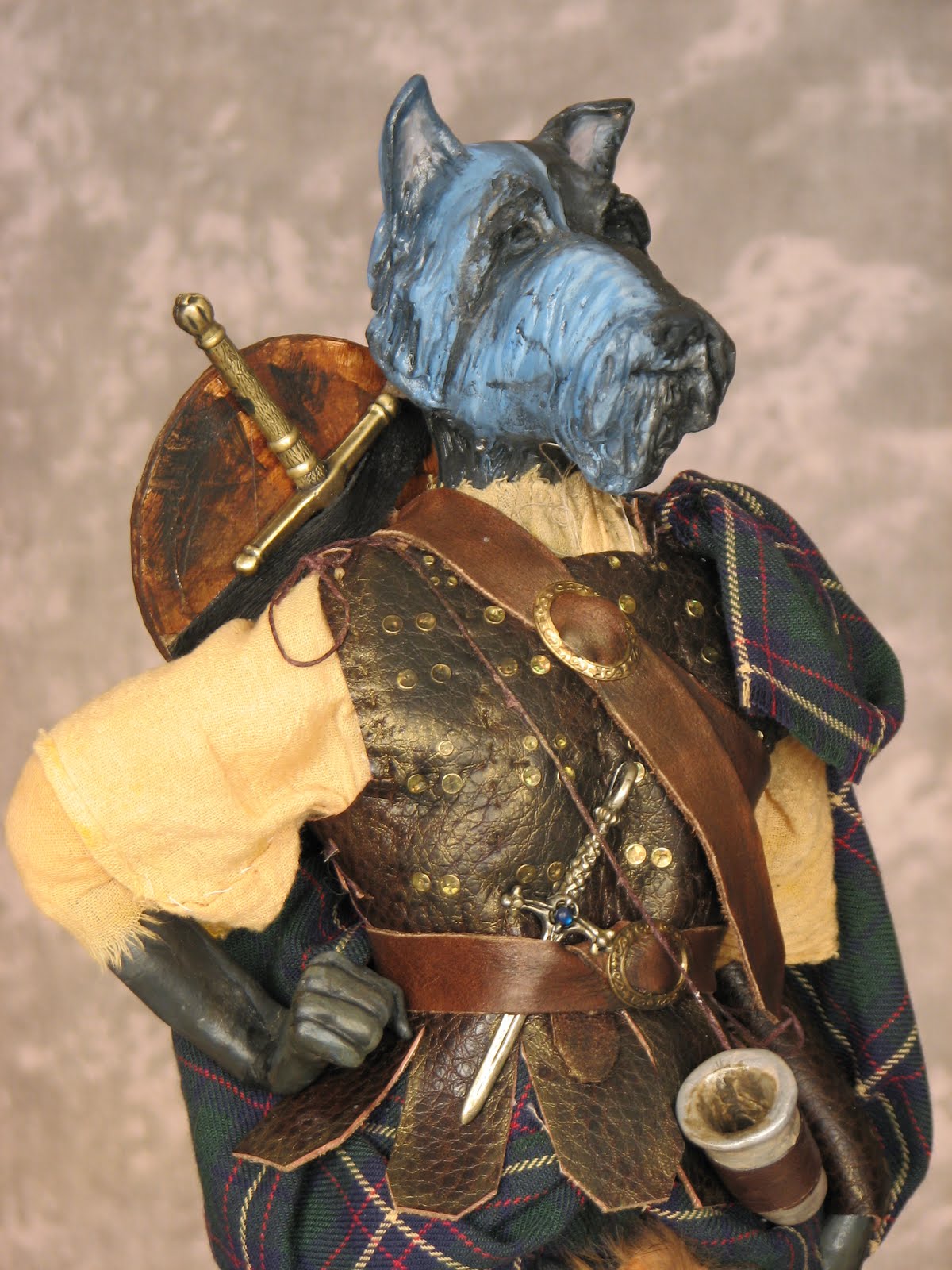
Since I last posted, I've made a couple of vampire fairies--characters who appear in my second novel, which I'm working on in between rewrites of the first. Caledonia and Scotia are their names.

I'm also deeply involved in a commissioned figure of Anne Boleyn. She has been challenging, to say the least, but I'm finally making headway. She has a bit of the feel of a Renaissance Italian Madonna to her. I like that about her. I only hope the client does, too. I'm having a little trouble finding a good faux fur (the client wanted faux, although I prefer the richness of the real thing).

Halloween here was uneventful. I'm busy devouring the left-over Mounds and Milky Ways ... which my waistline sure as heck doesn't need!

Here's a shout-out to Kimberley in Paris and Michael in Fife. Michael, are you busy with the by-election, or have you stopped speaking to me? I miss hearing from you!

Life is good.

Nina

Sep 13, 2009

Miscellany

Still working on the first book, but making progress. Been working on making the whole book darker and more literary; my vampire hero more tortured, complex, and empathetic; and his love interest more empathetic and multi-dimensional.

In dollmaking, I've decided to enter the Alexander Hamilton figure I've reworking in the DAR American Heritage contest. Hamilton got a pretty extensive body make-over after he appeared in ADQ. He's more proportional now ... but his old clothes no longer fit ... so I'm making him a new wardrobe. I had an old silk blouse that got a stain on the front the dry-cleaner couldn't get out, so I decided to recycle it as a waist-coat and bayan for Hamilton. I'm working on the waistcoat now. I'm also thinking of making him a black satin frockcoat, lined with the oriental silk, so he has some wardrobe options ... one for going out when he's playing the lawyer and statesman; one for staying home when he's playing the essayist and lover (not that he didn't go out to play the lover at times ... but he'll have to do that in his coat for the sake of propriety). Ha!

Not much else to report. We reclusive middle-aged artists lead a pretty dull life on the whole. But I had enough drama in the early years to last me a lifetime. Now I prefer quiet and solitude.

Nina

Aug 31, 2009

Rewriting

A few weeks ago, I checked out a book from the local public library about novel writing. In it, a famous writer was quoted as saying: novel writing isn't writing ... it's rewriting.

Well, I've been remiss on the blog of late because I've been immersed in rewriting my manuscript for my first novel. I don't have an agent yet ... but I've got someone who's been very encouraging after rejecting it twice (not because it isn't good, presumably, but because it isn't yet right for her). Anyhoo, it's getting a total overhaul and a new title: The Heart of the Beast.

But that doesn't mean I haven't been sneaking into the studio and playing with my dolls! But I've mostly been reworking existing dolls ... not making anything new. My Robert Hamilton is gradually getting an entire Scottish wardrobe. Including hats. Robert looks good in hats (and kilts). So far, he's got a regimental uniform circa 1790 and a Jacobite-era belted plaid and waistcoat. Hatwise, I made him a Jacobite beret, a glengarry and a big fur busby. I have too much fun, don't I? Right now I'm reworking my Alexander Hamilton that was featured in Art Doll Quarterly. I can't help it! I keep improving my techniques and feel the need to keep improving my favorite figures! Hamilton (A. not R.) got a body resculpt, resculpted legs, repainted face, and all new hands/arms. He's also getting kilted. Hey, he was Scottish! Don't know if he ever wore a kilt ... but who's to say?

Dan's out of town this week dealing with his aging mom, so I'm chauffering Miss Emma to school and back. Gotta go pick her up in a minute from Girl Scout's ... so I thought I'd pop in and say "hey" while I had a minute.

Nina

Aug 1, 2009

Vampire Bill Compton's Coffin

Here's a picture of Vampire Bill in the pine coffin Dan made for him. It can stand or lie down and the lid fits snuggly with a lip. Pretty cool, eh?

Tina at Trueblood-News.com asked if Dan would consider making more as trinket or jewelry boxes for people. He said he would, for about $75 a pop. He's also thinking now about making fancier coffin jewelry boxes.

Nina

Jul 31, 2009

Why Vampires Never Die

The following op-ed piece by Guillermo del Toro and Chuck Hogan was published yesterday in the New York Times.

TONIGHT, you or someone you love will likely be visited by a vampire — on cable television or the big screen, or in the bookstore. Our own novel describes a modern-day epidemic that spreads across New York City.

It all started nearly 200 years ago. It was the “Year Without a Summer” of 1816, when ash from volcanic eruptions lowered temperatures around the globe, giving rise to widespread famine. A few friends gathered at the Villa Diodati on Lake Geneva and decided to engage in a small competition to see who could come up with the most terrifying tale — and the two great monsters of the modern age were born.

One was created by Mary Godwin, soon to become Mary Shelley, whose Dr. Frankenstein gave life to a desolate creature. The other monster was less created than fused. John William Polidori stitched together folklore, personal resentment and erotic anxieties into “The Vampyre,” a story that is the basis for vampires as they are understood today.

With “The Vampyre,” Polidori gave birth to the two main branches of vampiric fiction: the vampire as romantic hero, and the vampire as undead monster. This ambivalence may reflect Polidori’s own, as it is widely accepted that Lord Ruthven, the titular creature, was based upon Lord Byron — literary superstar of the era and another resident of the lakeside villa that fateful summer. Polidori tended to Byron day and night, both as his doctor and most devoted groupie. But Polidori resented him as well: Byron was dashing and brilliant, while the poor doctor had a rather drab talent and unremarkable physique.

But this was just a new twist to a very old idea. The myth, established well before the invention of the word “vampire,” seems to cross every culture, language and era. The Indian Baital, the Ch’ing Shih in China, and the Romanian Strigoi are but a few of its names. The creature seems to be as old as Babylonia and Sumer. Or even older.

The vampire may originate from a repressed memory we had as primates. Perhaps at some point we were — out of necessity — cannibalistic. As soon as we became sedentary, agricultural tribes with social boundaries, one seminal myth might have featured our ancestors as primitive beasts who slept in the cold loam of the earth and fed off the salty blood of the living.

Monsters, like angels, are invoked by our individual and collective needs. Today, much as during that gloomy summer in 1816, we feel the need to seek their cold embrace.

Herein lies an important clue: in contrast to timeless creatures like the dragon, the vampire does not seek to obliterate us, but instead offers a peculiar brand of blood alchemy. For as his contagion bestows its nocturnal gift, the vampire transforms our vile, mortal selves into the gold of eternal youth, and instills in us something that every social construct seeks to quash: primal lust. If youth is desire married with unending possibility, then vampire lust creates within us a delicious void, one we long to fulfill.

In other words, whereas other monsters emphasize what is mortal in us, the vampire emphasizes the eternal in us. Through the panacea of its blood it turns the lead of our toxic flesh into golden matter.

In a society that moves as fast as ours, where every week a new “blockbuster” must be enthroned at the box office, or where idols are fabricated by consensus every new television season, the promise of something everlasting, something truly eternal, holds a special allure. As a seductive figure, the vampire is as flexible and polyvalent as ever. Witness its slow mutation from the pansexual, decadent Anne Rice creatures to the current permutations — promising anything from chaste eternal love to wild nocturnal escapades — and there you will find the true essence of immortality: adaptability.

Vampires find their niche and mutate at an accelerated rate now — in the past one would see, for decades, the same variety of fiend, repeated in multiple storylines. Now, vampires simultaneously occur in all forms and tap into our every need: soap opera storylines, sexual liberation, noir detective fiction, etc. The myth seems to be twittering promiscuously to serve all avenues of life, from cereal boxes to romantic fiction. The fast pace of technology accelerates its viral dispersion in our culture.

But if Polidori remains the roots in the genealogy of our creature, the most widely known vampire was birthed by Bram Stoker in 1897.

Part of the reason for the great success of his “Dracula” is generally acknowledged to be its appearance at a time of great technological revolution. The narrative is full of new gadgets (telegraphs, typing machines), various forms of communication (diaries, ship logs), and cutting-edge science (blood transfusions) — a mash-up of ancient myth in conflict with the world of the present.

Today as well, we stand at the rich uncertain dawn of a new level of scientific innovation. The wireless technology we carry in our pockets today was the stuff of the science fiction in our youth. Our technological arrogance mirrors more and more the Wellsian dystopia of dissatisfaction, while allowing us to feel safe and connected at all times. We can call, see or hear almost anything and anyone no matter where we are. For most people then, the only remote place remains within. “Know thyself” we do not.

Despite our obsessive harnessing of information, we are still ultimately vulnerable to our fates and our nightmares. We enthrone the deadly virus in the very same way that “Dracula” allowed the British public to believe in monsters: through science. Science becomes the modern man’s superstition. It allows him to experience fear and awe again, and to believe in the things he cannot see.

And through awe, we once again regain spiritual humility. The current vampire pandemic serves to remind us that we have no true jurisdiction over our bodies, our climate or our very souls. Monsters will always provide the possibility of mystery in our mundane “reality show” lives, hinting at a larger spiritual world; for if there are demons in our midst, there surely must be angels lurking nearby as well. In the vampire we find Eros and Thanatos fused together in archetypal embrace, spiraling through the ages, undying.

Forever.

Guillermo del Toro, the director of “Pan’s Labyrinth,” and Chuck Hogan are the authors of “The Strain,” a novel.

In other news, this week’s Entertainment Weekly delivers the ultimate guide to vampires. You’ll find interviews with the authors behind Twilight and True Blood, our list of the 20 greatest bloodsuckers ever, and Anne Rice’s pick for the best new vampire — as well as a talk with her about how she revolutionized the vampire legend decades ago with Interview with a Vampire.

Jul 30, 2009

James Moray of Abercairney


Okay. Here's photos of work in progress of the "Eve of the '45" Highlander figure. He's based on a portrait of James Moray of Abercairney, who, according to the portrait description in my tartan book, was a clan chief. I've been unable to find out what became of him after the Battle of Culloden, so, if you know, please help out. Jimmy is proud as hell. Seriously, look at his face and his stance. He's not quite finished. His basket hilt Highlander sword is coming tomorrow. After it arrives, he needs a shoulder strap and hilt. Dan thinks the strap on him is too glitzy, but I like it. What do ya'll think (that would be the red, gold and black ribbon across his shoulder). Stay tuned for more ...

Jul 29, 2009

A Taste of Tartan

The other day, I was out antiquing with my sister when I came across a lovely little book on tartan. It was inexpensive, so I bought it without taking the time to flip through it. When I got to the car, I pulled it out of the sack and was delighted to discover that it wasn't just pictures of swatches, but the actual history of tartan, complete with historic images and illustrations. Well, that inspired me to start on a new figure based on one of the images in the book of a clan chief on the eve of The '45. He's wearing a period coat and shirt over a traditional belted plaid, which combines my passions for 18th century and Scottish costume. Jimmy, as I call him, is a full sculpt, meaning he's completely sculpted from clay, rather than part clay and part cloth. Well, except for his upper arms, which need to bend so I can get him into his clothes. In the painting, he's outfitted with a sword and dirk and there's a very nasty looking shield in the background with a spike extending out of the center. Yesterday (and boy was I excited) I found the perfect sword for him online: a Scottish basket hilt letter opener! Yowza!

Okay, so. My love affair with Scotland and tartan continues. I'm thinking of doing a whole series of Highland figures in traditional dress from varying time periods. Ambitious, yes. Guess we'll see if I can pull it off.

In the meantime, here's a little bit of history from my second novel, Bloodlust. This bit is stuck in between the Inverness Highland Games, where Robert (our vampire hero) is giving a political speech and tossing a caber and an interview he gives with a seductive reporter from the local newspaper.

Tartan plaid, far more than a repeating pattern of dyed wool woof and warp, has long been a symbol of Scottish pride and independence. That’s why it was the uniform of choice for the Jacobite uprising in 1745. And that’s why the English banned the wearing of all tartan and other forms of Highland dress in Scotland the year after the rebellion. The ban, a poison arrow aimed right at the heart of Highlander heritage, extended to the wearing of kilts (tartan skirts), trewes (tight tartan trousers), or philabegs (baggy tartan shorts); the playing of the bagpipes; the speaking of Scottish Gaelic; the bearing of all arms; and the gathering of clansmen. The penalty for a first offense was six months in prison. A second offense initially carried a sentence of seven years hard labor on a colonial plantation, but was later changed to a forced term of service in the British army in America, which chiefly defended the colony against the French, the strongest of Scotland’s allies.

The demoralizing measure was crafted to crush Scotland’s ancient clan culture as a means of squelching any lingering pro-Jacobite sentiments in the Highlands. Suspected sympathizers were forced to take an oath, which demonstrated England’s shrewd understanding of the character of the Scottish people:

“I ... do swear, and as I shall have to answer to God at the great day of judgment, I have not nor shall have in my possession, any gun, sword, pistol or arm whatever: and never use any tartan, plaid or any part of the Highland garb, and if I do so, may I be cursed in my undertakings, family, and property--may I never see my wife and children, father, mother, and relations--may I be killed in battle as a coward, and lie without Christian burial in a strange land, far from the graves of my forefathers and kindred-- may all this come across me if I break my oath.”

The ban elicited outrage and resentment among Highlanders, who vowed “it would take more than an act of Parliament to stop the Highlander wearing his traditional clothes.” But stop them it did. The ban, which lasted thirty-six years, was strictly enforced. In the span of two generations, the wearing and the weaving of tartan plaid virtually ceased with many ancient patterns and traditions forever lost along the way.

But what the measure took with one hand, it inadvertently gave with the other. The ban imbued the forbidden cloth with an air of danger and intrigue. The romanticism surrounding tartan was further enhanced by its continued use in the Highland regiments, the only group of Scotsmen exempted from the ban. The fighting prowess of the Scots, their continued wish to wear the kilt and tartan, and the standardization of many setts in a military form all contributed over time to a mood of public support for lifting the ban. So did the fading public memory of Culloden and wider acceptance in Scotland of the new British king.

Thus, in June 1782 in Parliament, the Marquis of Graham, who helped form the Highland Society of London, moved “that the clause of the nineteenth year of George II, which prohibits the wearing of the Scotch Highland dress, be repealed.

There was but one dissenting voice: Sir Philip Jennings Clerke, who wanted to have Highland dress confined to Scotland for the protection of the ladies. In making his plea, he relayed to the members of the House a story he had been told by a Hampshire innkeeper, who had recently quartered four officers of a Scottish regiment. The innkeeper complained that his wife and daughters were so taken with the men’s kilts and bare legs that he’d spent the duration of their visit keeping an eye on his women.

Jul 24, 2009

Scottish Independence

Of all things, I've been immersed for the past few weeks in research on the issues and arguments surrounding Scottish independence for my second novel, Bloodlust. In it, my 200-year-old Scottish vampire, Robert Hamilton, is running for a Scottish seat in the Parliament at Westminster. The book spends a lot of time on Scottish history, culture, folklore, and scenery. I hope to actually get to Scotland next summer, but in the meantime, the Internet has provided a ton of useful resources!

Anyway, I'm telling you all this because there was a story on NPR yesterday about the fight for Scottish Independence that encapsulates things pretty darn well. If you're interested, check it out. You just might learn something! Calls for Scottish Independence Still Strong